Author: S34H0rs3B00ks_IUHBVFfreS

  • The Path Of Kai Men

    The Path Of Kai Men

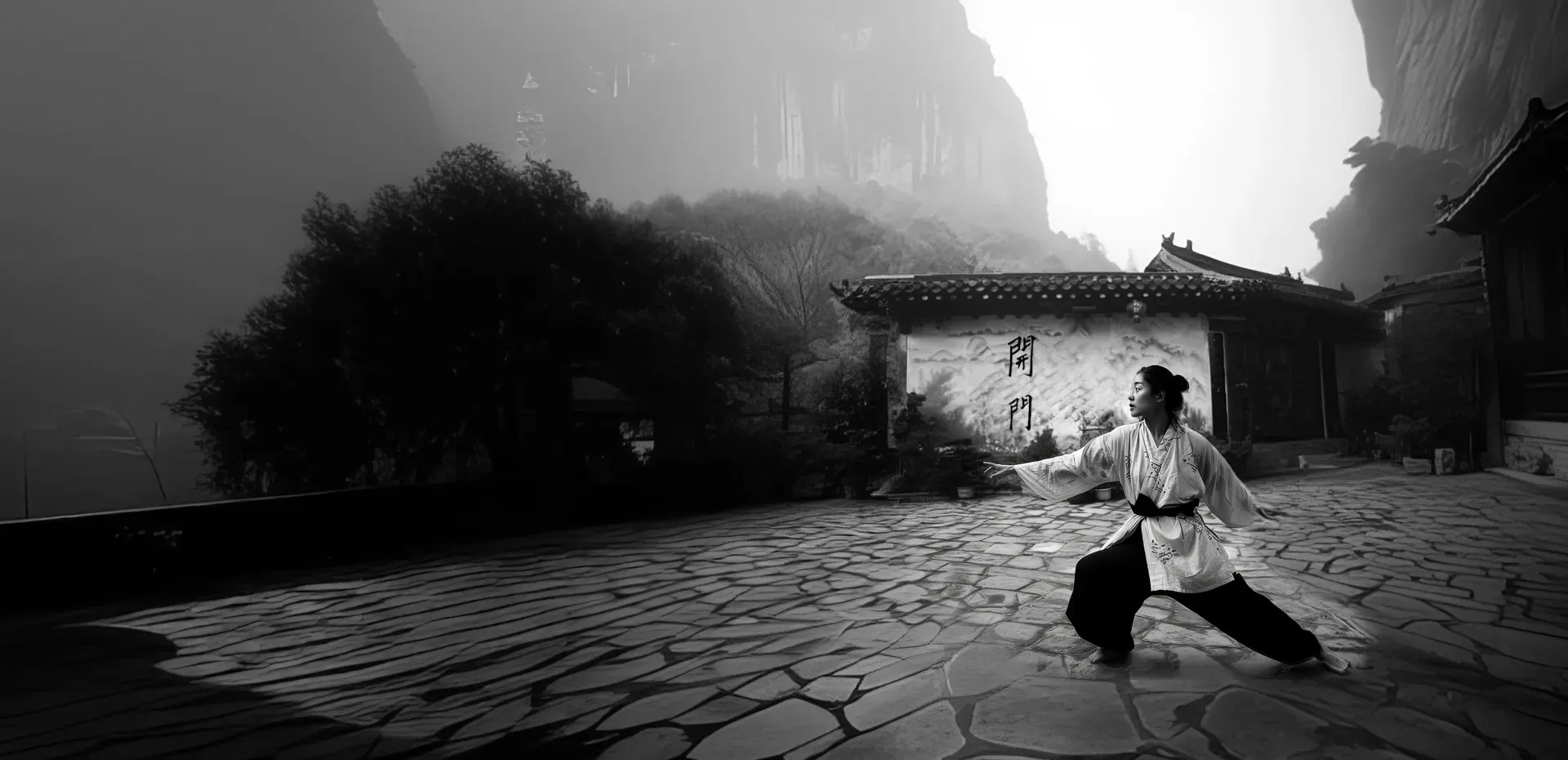
    Taoist yoga has long been known as the “Open Door” (Kāimén 开门), although at various times in its long history it has also been referred to as Hébing 合并 (“Unity”) and Héxié 和谐 (“Harmony”). Kai Men is the most appropriate name, however, as it expresses the idea that Taoist yoga is the doorway to all the channels of the mind, the spirit and the body. All these, while retaining their separate identity, are as one, so reflecting the balance of Yin and Yang and the Dual Monism of all in the universe.

    As outlined in the previous chapter, the foundations of Taoism, and, thus, of Kai Men itself, were laid down in the Primitive Period of Chinese history. During that period, the first golden rules for all Taoists to follow were laid down, and one of the most fundamental of these was “Never harass, never hinder, never harm and never hurt anyone, either by thought or by deed.” Living and thinking this is hard, but the good sense and morality of it are undeniable.

    Do fish in the water complain that it is cold or dirty? Of course not. Do they complain because the sea becomes rough, or envy or try to exploit each other? No. They live in harmony constantly, never envying or hating anything. Life for them is simply living. There are no comparisons in nature, and even love is meaningless outside the world of mankind.

    It is living now that matters. The way to the spirit is through constant good thoughts and good deeds, now and every minute of each day, and through this way of life everything becomes an “open door” and the Tao becomes apparent to you in everything you do, and in every thought that passes through your head. As the very first step towards attaining full control of yourself and deepening your consciousness and awareness, you must purify the internal and physical side of your life by sensible eating and drinking habits. Eating the Chang Ming way will purify your internal organs, bring you good health, and so make you feel fitter and more relaxed than you have ever been before. In following this course, it matters not what your religion might be, for Taoism is not a religion — not even a belief or a trend of thought — for it is the pathway, the road, the track, of your own way of life, which was laid down for you long before you were ever born. Have the good sense to follow it, have the initiative to learn, have the understanding to exercise control, and be aware not only of what is going on around you, but also, and most important, of what is going on inside yourself. Having got on to the path of sensible eating and drinking, so learning to behave as a part of nature and become closer to it, the next step for you to take is to aid the energies of your own body to realize their true potential. These energies fall into four very simple categories.

    1. Physical Energy

    The physical energy of your body is utilized through the muscles and tissues of your anatomy, so that, when, for instance, you lift something, these automatically come into effect. In K’ai Men we call these “muscle changes” and it is through muscle changes within the body that the exercises of K’ai Men are most effective. Through the muscles of the body we begin to open up the channels that are necessary steps towards opening every door within us. Good eating and drinking habits help towards this by making the tissue of the body more flexible, and, whilst you slowly grow older in years, they still remain young in their texture. Revitalizing the body comes not only through our daily eating habits but also by specialized and constant deep breathing exercises, which not only help the normal channels to attain added vigour, but also assist the psychic channels of the body to be opened and strengthened.

    In addition to the muscular system, we also have within us an intricate system of blood vessels, which takes the goodness to every part of the body. It is aided by a complex nervous system. Whilst being separate in their specialized fields they all operate as one within the human frame. In addition to sensible eating and drinking habits, to make the body even healthier, to gain vitality, and to assist in the cleansing of the whole system, it is essential to have an adequate supply of oxygen. So deep breathing constantly is also a must for the purification and energizing of the body.

    2. Mental Energy

    To enable the mind to be the constant link with the spirit, passing messages back and forwards, to have it in constant control of every thought, every emotion, every sense, and every action of the body and limbs, no matter how minute that movement might be, you will readily understand that it requires enormous energy. It is when the mind becomes depleted of vitality and energy that you begin to feel listless and tired. Concentration itself burns up terrific amounts of energy, so, if you seriously want to meditate, ensure that your body has the energy and vitalities within it to be able to feed the mind in accordance with all its needs and requirements. Good and proper eating and drinking habits, coupled with constant and regular deep breathing every minute of your life, are therefore a must.

    3. Internal Energy

    Apart from the physical and mental energies of the body, we have what is commonly known as “internal energy” (Nèi zhōng qì 内中气) or, more technically, as “intrinsic energy” (Tiānrán néngli 天然能力), but most people who practise the Chinese arts call it the “vitality power” (Shēngqì 生气). One of the objectives of all those who practise the Chinese arts is to arouse, cultivate, develop and control its dynamic force. There is nothing mysterious about it, for it is the natural energy of the body, and everyone is born with it. You see this power come into action when, for instance, a little baby grips your finger. It has not had time to develop any muscles, yet it will grip your finger so tightly that you may wonder how it could do so. Unfortunately, when you reach five or six years of age you begin using your physical strength so much that your internal energy or vitality power becomes almost dormant, and you use very little of it as you grow older. This natural power of your body enables you to do your everyday work without the use of physical strength, and without running yourself down and becoming tired and listless. Have you noticed how weary and run down you seem to get round about October and November of each year? This is because you have just entered a Yin period of the year, which always affects the muscles, tissues and bones of the body. If you rely too much on the physical side of your body to do your daily work, you will certainly feel the strain. Internal energy helps to revitalize the various functional, control and psychic centres within the body so that they not only become more supple and flexible, but also become more receptive. In addition to this, it enables you to meditate much more strongly, because the mind has an unlimited source of energy that it can call upon at any time, whenever it requires it. This energy is built up through many various breathing exercises. All of these have specific jobs to do, but their main task is to heat up the Lower Stove or Cauldron (Xià lú 下炉) or Golden Stove (Jīn lú 金炉), as it is referred to in Taoism, which lies in a position about thirty-four millimetres below the navel. The heat so generated creates and activates the vitality force.

    The benefit that the body derives from this power is beyond normal appreciation and comprehension, but in its own way it fights bacteria within the body and your body health improves enormously, so that colds and influenza, along with other complaints, become things of the past. Most Westerners, however, if confronted by a demonstration of the dynamic power of internal energy, would rather explain it away as hypnotism, or whatever, than believe the evidence of their eyes. This vitality power is so powerful that with the use of it almost everything is possible: a woman might withstand forty or fifty men pushing against one of her hands. Besides improving the health of the human body, and one’s physical powers, this vitality power helps the lift-off of your spirit when you die, and, if you desire to meditate whether internally (mentally) or externally (spiritually), this internal power will enable you to transmit or transport to the furthermost paths of the spiritual world. Without this energy, meditation will be a failure. Many people have traveled the whole world trying to seriously meditate, yet so many come back to the point from where they started disillusioned and disappointed — only to find that what they were looking for was within themselves all the time, and that they need not have taken a single step outside their door to find it.

    4. Macro-cosmic Energy

    The other source of energy that is vital to our own personal lives is “macro-cosmic energy” (Jīng shēng lì 精生力), which was a part of your life before you left your mother’s womb. This energy comes down from the heavens, passes through all Yang things, with a centripetal circular motion, and enters the earth, where it gathers further vitality. It then returns to heaven, passing through all Yin things, with a centrifugal circular action. The general movement of the energy is thus as follows:
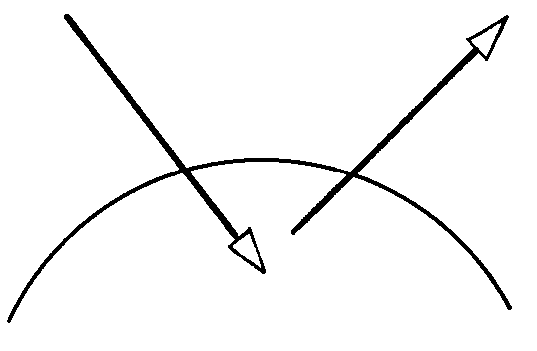
    In passing through Yang things on its way to earth, it passes through man — down his spine and out from his abdomen. Conversely, in passing through Yin things on its way back to heaven, it passes through woman — up her spine, round the head and out through the mouth. The two directions may be represented as follows:
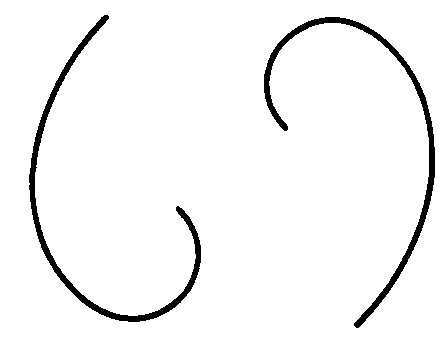
    If you put the two together, the result is the famous Yin and Yang symbol of China, representing the unity and duality, the Dual Monism, of all things.
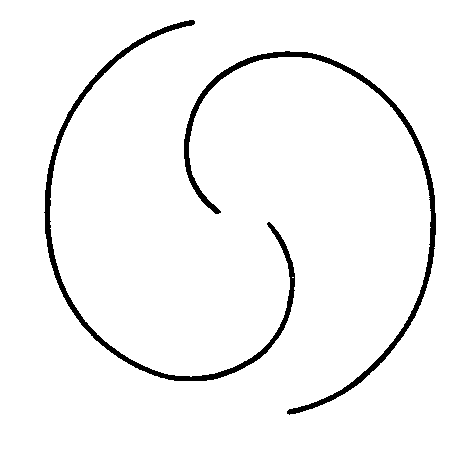
    Our bodies, the persons that we are, the food that we eat, the water that we drink, and even the illnesses that we suffer all depend on the balance or unbalance of Yin and Yang. Mentally, physically and spiritually everything is governed by these two simple elements, and nothing is totally one or the other, though some things are predominately Yin or Yang.

    Macro-cosmic energy is everywhere, and it passes through you constantly. If you learn to store it, harness it, control it and learn to mix it with your vitality power you can reach the realms of immortality. This source of energy enabled many of the sages and philosophers of ancient China to live to 150 to 200 years of age, and Laozi is said by some to have lived for over 300 years here on earth. But you too can join us in the knowledge that age is only the number of earth years, and at sixty you can still have the skin, the mind and the energy and vitality that you had when you were twenty. Time is nothing; it is how you use it, live it and utilize it that really matters, and your present life and your spiritual growth depend on it. Don’t let precious days slip by wasted; learn to live properly, and attain some physical, mental and spiritual satisfaction in your life, and seriously take up the study of Kai Men, so as to learn what makes you tick, and how all the energies of the body can be utilized and strengthened. There is an open door, just walk in, and start learning a little bit more about yourself.

    When you have built up the internal and external energies of your body, you can then begin to develop your spiritual control, consciousness and understanding. To have this control of oneself, you must start with your way of living, always thinking good, doing good, and never harassing, hindering, harming or hurting anyone, by word, by thought or by deed, and learning to serve others here on earth, and the Supreme Spirit (God).

    First of all try and understand yourself every minute of every day, and try not to make any comparisons at any time. Remember that there is nothing good, and nothing bad, for it is only humans who always try and set standards by making one thing a bit better than another, or make it worse by comparing it with something else. There are no comparisons in nature. All things are equal, and we are all exactly the same, and no one or no thing is any better or worse than something else, no matter how or what or why we live from day to day.

    The material things of life, the Rolls Royces, the big diamonds, the beautiful clothes, are nothing, but nothing will stop you buying them if your concern is to show others how well off you are, or that you are better than they. But remember seriously that you were born with nothing and will die with nothing, and so learn to live with nothing. In so doing you will find that all things will be found for you, and you will never have to make a decision; never have to worry about this or that; and never even give a second thought to how you are going to survive. This is the Tao, a way of life that, once you have learned to accept it, will show you how wonderful life is and how beautiful is nature, of which we all are an integral part. So try to understand the Tao, try to be a part of it constantly, and in so doing try very hard to understand and appreciate all of it within yourself.

    If you scratch your hand, or stub your toe, or if you drop something, then immediately stop to think back within the last thirty seconds or one minute, and try and collect your thoughts and remember if you had a bad thought during this time, because this could possibly be what we know in Taoism as the Law of Repercussion (Yīnguǒ 因果). If you do something more serious — that is, harass or harm somebody — then you can guarantee that someone will be doing the same to you, if not quite in the same way, within a very short space of time. So learn to try and understand it, endeavour to see it and in so doing learn to appreciate it. Then your eyes will be opened and you will begin to see the Tao. This understanding takes time, but, if you get into the habit of turning your thoughts inwards, you will start to understand the outward sphere of things that happen in your life every day.

    The violence in this world is only what we make it ourselves; these are the repercussions of our own deeds. There is no danger for those who truly live the way of the Tao, because if you think no evil, and do no evil, then evil will not exist.

    When we no longer think of good deeds and good thoughts, then even goodness disappears. When we no longer see bad thoughts and bad deeds, then badness itself will disappear. When we no longer compare one with another then all disappear, and we understand the Tao.

    Say your prayers regularly, whatever your religion; say them morning, noon and night. You are a part of the spiritual world, it is a part of you, we are one and, although we seem separate in our physical, earthly bodies, this is nonetheless true. To realize this and think along these lines is the beginning of spiritual growth, spiritual maturity, spiritual advancement within yourself, and this is the true understanding of the spiritual world, of which we are an integral part. This is the object of the “Open Door” (Kai Men) through the physical exercises, which will enable the whole of the body to be opened and therefore become more receptive; through the specialized breathing exercises, which will help to strengthen and revitalize the various channels and centres within our human body, which will establish the links with the mind; and through our thoughts and our deeds, which will open the way to our spiritual growth, our advancement, and our spiritual maturity. This is the true path of the Open Door, which never closes, yet many never try to open it at all.

    When you have done all these things and lived the way of the Tao and have tried to understand it, become conscious of it, aware of it to the point of becoming enlightened, then, having made this circuit, you will come back to the beginning. You will have made the complete circle of the Yin and Yang of the physical, the mental and the spiritual, and will come back to the very commencement of all things — namely, yourself.
    The Taoist Art of Kai Men

    by Chee Soo
  • The Aims Towards Perfection

    The Aims Towards Perfection

    The Aims Towards Perfection

    Chapter 4.

    The Aims Towards Perfection

    The author of this book has been practising T’ai Chi Ch’uan for sixty years, and knows deep down inside that even though others may think what you do is perfect, something you feel and appreciate can continue to be understood ever more deeply as time goes on. Yes, perfection is a word that has no boundaries, for only you can fix the limit of yourself. However, from my own personal experience and from the foundations created by my own master, let me pass on a few tips that will help you in your training and practice, because your teacher cannot watch or be near you all the time during your endless search to become better and better.

    The Supreme Ultimate

    For the truly dedicated person this is the ultimate goal pointed out to us by the Taoists of ancient China, and from my own personal experience I know it is true. In simple words, it means the complete understanding, harmony and conquering of our body, mind, spirit, our own Chi energy and universal Li energy.

    The Body

    You will learn in the Taoist Cultural Arts Association that every movement has a meaning, every meaning contains a depth, and each depth contains an essence, and through the full utilization of the essence, you will find out the true meaning of the expressions that our old masters told us. Thus you will prove to yourself that ‘the weakest is the strongest’, ‘the lightest is the heaviest’, and ‘the shortest is the longest’. You will recognize these truths over and over again, until you are fully aware of the essence they contain, and how they can be utilized not only in our arts, but in your everyday life.

    The first golden rule is to let your body remain relaxed and natural at all times, without any tension whatsoever. But relaxation does not mean giving way completely and slumping as if you were a dead weight. It means being your natural self, without being artificial or going to the other extreme of trying to be too precise. T’ai Chi is therapeutic, for it gives very gentle exercise to all parts of the body. When you move the arms you exercise the legs, and when you activate the legs then you automatically exercise the upper parts of your body. So harmony within all movements is very important, and co-ordination between the upper limbs and lower extremities is an important aim towards perfection.

    The legs

    The legs are used to support the weight of your body at all times and even when you are lying down muscle changes take place through the legs as the body turns. The legs, therefore, play an important part in all movements of the torso, so never oppose these natural dynamics of your own body. Other styles of T’ai Chi have quite large stances, with their body weight supported between the two legs with both knees bent. This, you will be told, conforms to the laws of gravity. In a physical and materialistic sense they are right. We, on the other hand, explore the true meaning of the ‘Supreme Ultimate’ by using the essences that our legs can give, so you will find if you train with us that our weight distribution is changed for each particular stance, for this is essential to bring out the true essence that it contains. For instance, it is a golden rule in our T’ai Chi that when the foot is moved, the heel is placed on the floor first, then the ball of the foot, and finally the toes, just as if you were walking naturally. This movement from heel to toe is performed no matter what the angle of the foot might be, whether you step forward, back, or sideways, and even when you walk the air. This is not easy at first, so constant practice is recommended in order to maintain your balance while keeping control of your leg movements, which you should practise very slowly and lightly.

    Learn to move from one leg movement to another, and ensure that you check and correct them constantly. Using a full length mirror is an excellent way to correct yourself.

    The Arms and Hands

    Never fully straighten the arms, but always keep them slightly bent. Keep your elbows pointing down, except on the rare occasions when the arms are raised above head height. Ensure that your arms are completely relaxed, irrespective of how they are moved or held.

    The hand movements not only have a meaning in their flow from one direction to another, but there is a far greater depth and meaning within the essence that they contain. Perfection in the execution of the movements of hands and arms is very important indeed. There is a wise saying within our Taoist arts: ‘the slowest is the fastest’. One illustration of this is a learner driver, who, once having mastered the techniques of driving very slowly, may well gain sufficient experience one day to become a champion racing driver. This applies to our arts as well. Don’t rush, give yourself time to perfect a movement, harmonize it with your posture, stance and breathing, and feel the essence that it contains. Then and only then will you have acquired the mental control to harmonize every aspect in one beautiful technique – at any speed you wish.

    The hands are very important, but in our everyday life we are apt to take them for granted, and never really give them a second thought unless we injure them, in which case we feel very lost. They are also extremely important in T’ai Chi, because of the intricate movements and patterns they have to execute. Complete control over them is essential at all times, whether they are moving, stationary, open or closed into a fist. There are seven main types of hand formations. The first is the Sun Palm (Jih Shouchang). The hand is pushed forward with the fingers completely relaxed, but pointing upwards. In this formation the vitality power flows from the lower abdomen (Tan Tien) up the spine, down the arm and into the palm. This movement of the hand and arm looks very soft and gentle, but the force pushed out of the Sun Palm, with mental control, is quite dynamic. The second is the Cloudy Palm (Yun Shouchang). The back of the hand faces away from you and the palm is turned inward, fingers pointing upwards. The vitality power is recalled back to the lower abdomen. The hands and arms are completely relaxed and the shoulders are allowed to sink.

    The third is the Crane’s Head Palm (Hao T’ou Shouchang). The fingers point downwards. The shoulders, arms and hands are now completely relaxed and loose, with the vitality power having been recalled back to the lower abdomen. The fourth is the Lifting Palm (Chu Chi Shouchang). The back of the hand faces the floor and the palm faces upward. The vitality power may or may not be activated, whichever you decide.

    The fifth is the Side Palm (Pien Shouchang). The tip of the thumb points upwards, and the edge of the little finger downwards. In this formation the vitality power will remain stationary unless you wish to activate it through your mental control. The sixth is the Hammer Palm (Ch’ui Shouchang). The hand is firm, the palm faces downwards, and the little finger edge would, if required, become the striking edge. The vitality power flows very forcefully into the hand, especially to the little finger edge.

    The seventh is the Closed Palm, or fist (Kuan Shouchang). The fingers are closed into the palm but should remain fairly loose. The vitality power in this formation is rather restricted.

    The Head and Neck

    Some say that you should imagine your head being suspended but if you do then you become like a puppet, light-headed and floating. So don’t let your head and neck be stiff, like that of a robot; just keep them both naturally upright, without any tension, and align them both with your spine. One day you will be amazed at the depth of essence they contain.

    Breathing

    Breath is life, as we all know, but correct breathing is even more important than that. Not only does it sustain life and purify the blood, but it is also the fuel for the vitality energy of the body, just as coal is fuel for a fire.

    In your early days of training, however, we suggest that you shouldn’t worry too much about breathing. If you join one of our affiliated clubs or classes you will be taught many specialized breathing exercises, but for the beginner who practises at home without an instructor, we suggest that you first practise some of the sequences over and over again. This will enable you to attain the perfection of stances and postures and a continuous flow of movement, and during these early periods you should just breathe naturally through the nose as you practise. As all movements of our T’ai Chi Ch’uan style are based on an in-and-out movement, breathing can easily be harmonized with them. On the odd numbers or inward movements you should breathe in, and on the even numbers or outward movements you should breathe out. Your health will feel the benefit, and you will gradually learn to take deeper and longer breaths as you learn to co-ordinate the length of your inhalations and exhalations with your movements.

    Next, try and learn to breathe in through the nose and out through the mouth when practising the movements, and time them to your breathing, rather than timing your breathing to your movements.

    The next stage is to learn to breathe deeply into the area below your navel. Lower abdominal breathing (Tan Tien Ch’i Hsi) not only excites and activates the vitality power, but it also helps to give you an internal massage by the expansion and contraction of the muscles and the intestines. It helps to improve blood circulation and liver functions and generally aids the working of the body metabolism. At first you will have to concentrate the mind on the sinking of the breath down to the Tan Tien. In Taoist thought and Chinese alchemy, the lower abdomen is known as ‘the lower cauldron’, and it can only be reached and activated by deep diaphragmatic breathing (what the Taoists call Yang breathing). The Tan Tien is also a psychic centre of primary importance, and the main centre for the storage and circulation of Chi and Li energies. The harmonious mixture of Chi and Li energies in the lower abdomen is known in Taoist thought as ‘the Inner Circle’. The same area also acts as the centre of the ‘Outer Circle’ of the body, which governs the spiritual and psychic channels of the mind and body. It must therefore be looked after, nurtured and protected, for it is of prime importance for the health of your body, mind and spirit, in both their internal and their external activities.

    The Golden Principles (Chin Tao Li) of T’ai Chi Ch’uan

    1. Keep your body erect without stiffness.
    2. Everything about you should be completely relaxed, especially the mind.
    3. Maintain the heel and toe principles for all foot movements.
    4. Co-ordinate the movements of the upper and lower halves of the body.
    5. Harmonize the internal and external physical aspects of the body.
    6. Ensure that there is a continuity of movement at all times, and that all movements follow a curve or circular form. Movements are never straight lines in T’ai Chi.
    7. Study the many Taoist breathing exercises.
    8. Learn to breathe deeply through your lower abdomen, and keep your tongue against the roof of your mouth.
    9. Extend and let your vitality power flow on all outward movements.
    10. Recall and relax your vitality power on all inward movements.
    11. Live the Ch’ang Ming way (Taoist macrobiotics).
    12. Study the laws of life within the realms of the spiritual path (Tao).
    13. Study the use and harmonization of the vitality power and macro-cosmic energy, which are the internal and external, physical and spiritual energies.

    The Chinese Art

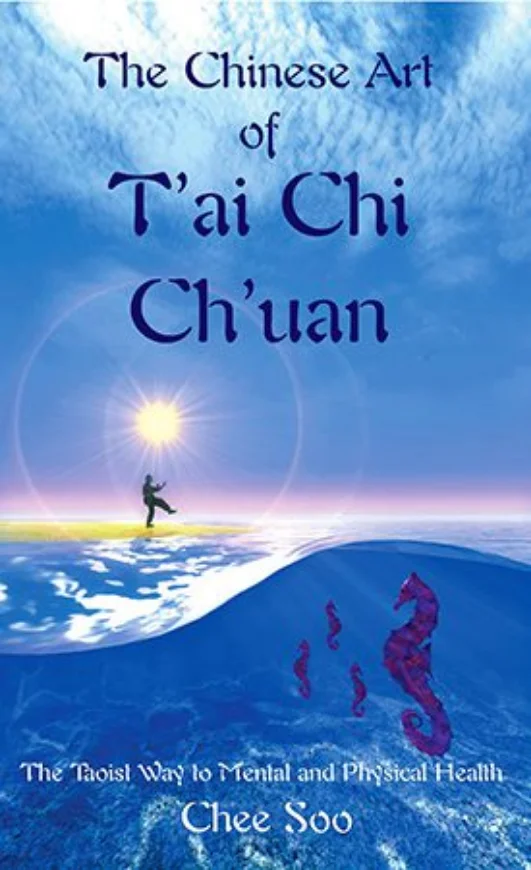
    The Chinese Art of T’ai Chi Ch’uan

    by Chee Soo

  • BBC Radio Interview

    BBC Radio Interview

    BBC Radio Interview

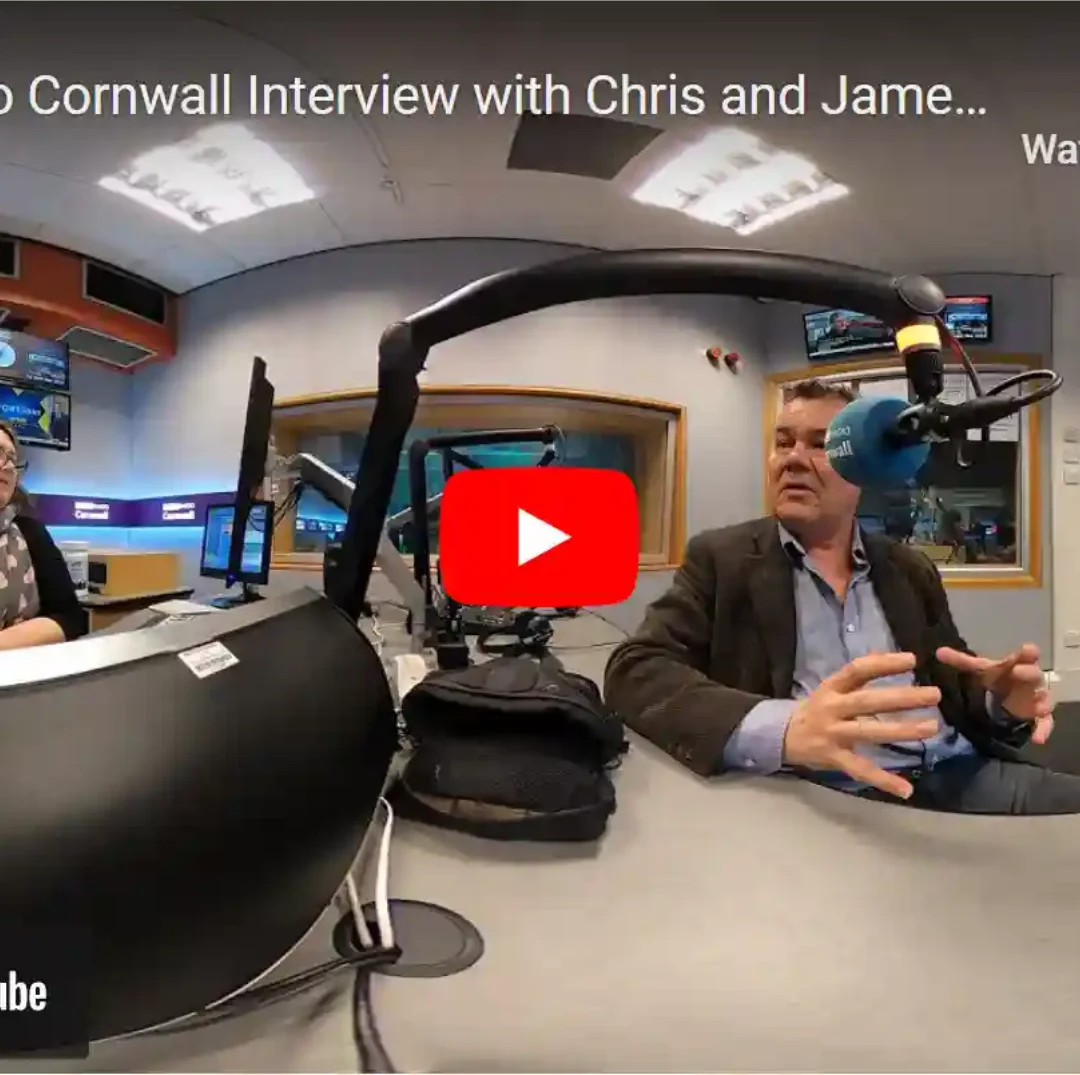
    Chris and James from Cornwall Tai Chi talking on the BBC

    Chris learned Tai Chi with Chee Soo in Leamington and Coventry and had a class at Warwick University.

    James took up Tai Chi after a serious road accident and now has his own class in his home town of St Agnes in Cornwall.

  • Complete Collection

    Complete Collection

    There’s a particular kind of student who, once they begin, doesn’t want to stop at one book. If that’s you – or if you’re building a personal library that grows alongside your practice – this one’s for you.

    Chee Soo told us about the elements, there are five, and each one is like an essence. They go together complementing each other like the fingers of your hand and sure you wouldn’t even want to lose the smallest one, would you?

    Think of a jigsaw puzzle, each piece has a space, then there’s a bit that fits into the space left by another piece. In this way the pieces fit together and interlock with each other like Yin and Yang. So when you start the puzzle at first everything seems like chaos, pieces one on top of the other, all at different angles, some upside down. Over time though you see similarities between pieces, and you start to organise them into groups and as you fit more and more pieces together then the pile of chaos gets less. It won’t take long before you have enough assembled to be able to see what the whole picture is about. It’s the same with the books, each one contains something that can help you solve a part of the puzzle from the other books. So the wushu gives you a practical test bed for your tai chi, and Ancient Chinese Energy meridian pathways and massage techniques form the basis for your wushu. Chang Ming provides the fuel you need to gather the Energy for your Qigong and Daoyin. Everything rests on something else.

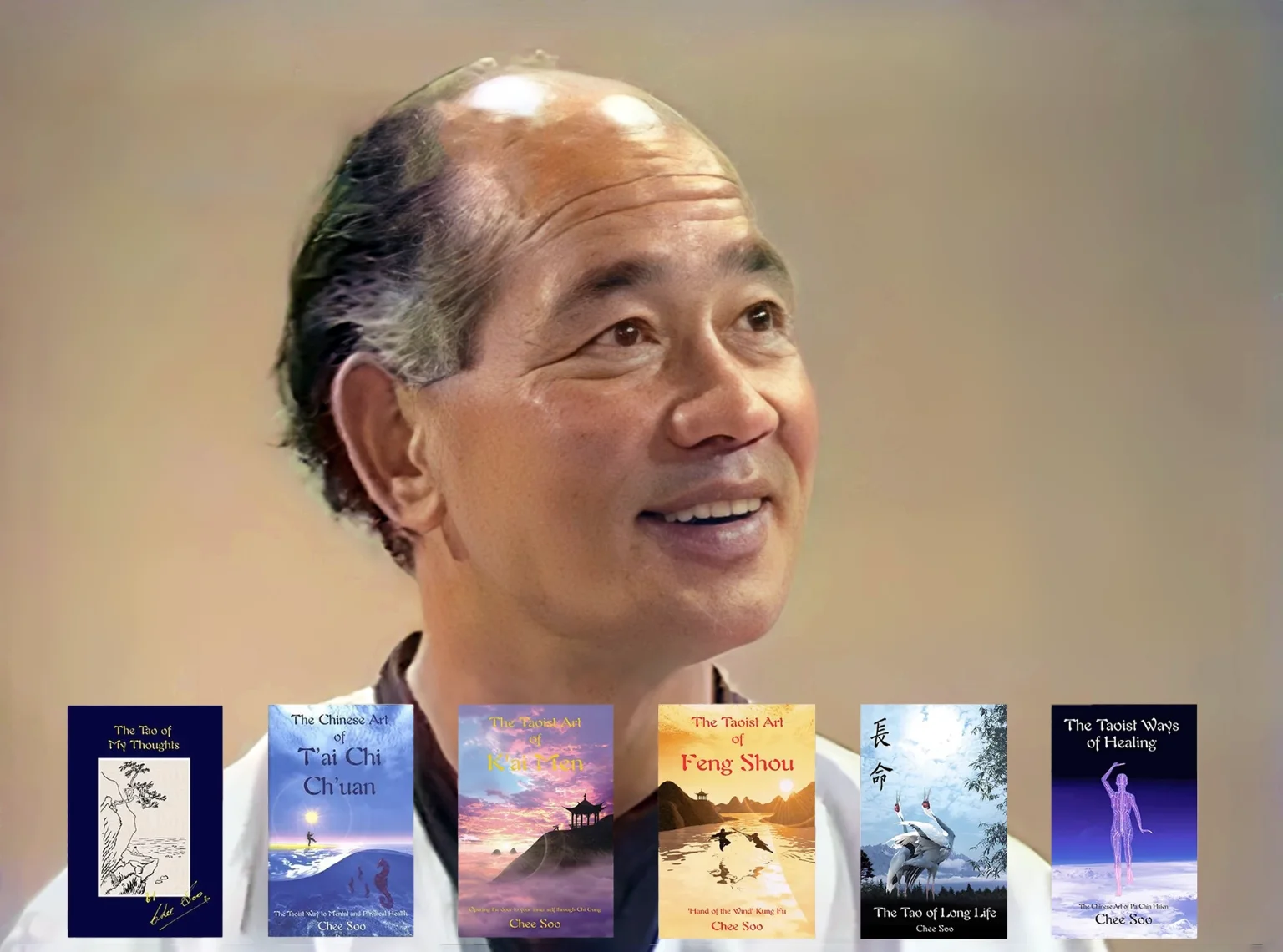
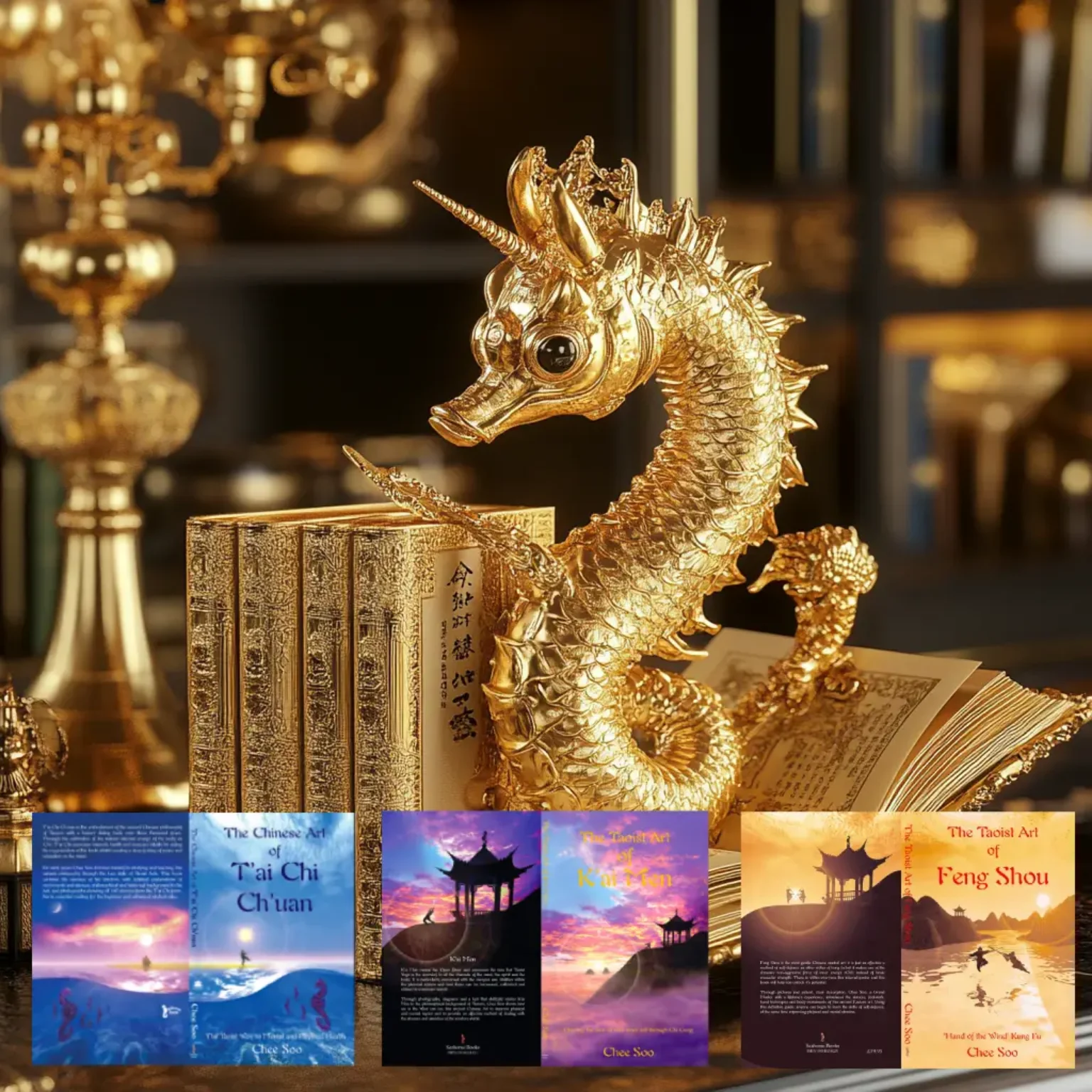
    The Complete Collection brings together all six titles: Tao of Long Life, Taoist Art of Feng Shou, Tao of My Thoughts, Taoist Ways of Healing, Taoist Art of Kai Men, and the Chinese Art of Tai Chi Ch’uan. Together, they trace a fuller picture than any single volume can – physical practice, philosophy, healing, and the quieter internal work that ties it all together.

    Bought separately, the six titles come to £103.70. As a complete set, they’re £84.95 – a saving of over £18, and a natural way to acquire the whole library in a single, considered purchase rather than piecing it together title by title over time.

    Get the Complete Collection here

  • Breath Is Life

    Breath Is Life

    Breath is Life

    Breathing is accepted as the most natural thing in the world, but very few people really consider how important to the body correct breathing is. We can all go without food and water for many days, yet, if we stop breathing for even thirty seconds, we quickly realize that we cannot do without air for even a short while. Yes, we accept breathing without ever giving it a serious thought, unless we have the misfortune to suffer a complaint such as hay fever, asthma or emphysema when breathing becomes really difficult.

    Through bad habits or ignorance, the majority of people breathe very shallowly, using only about one-third of their lung capacity on each breath intake. Owing to this, their health is likely to deteriorate – fatigue, sluggishness, tiredness, headaches, bronchial complaints, wheeziness in the throat, and so on, becoming the order of each day for them. Lack of oxygen can throw an undue strain on the heart and create many circulation problems, which in turn will affect the tissues and bone structure, decrease sexuality, and affect the glands, the whole nervous system, and all internal organs.

    Let us look at one or two of the complaints that people may suffer from mainly owing to poor or inadequate breathing.

    Emphysema, a complaint that is now widespread, though virtually unknown before the turn of the century, has now increased, and every day sees an increase in the numbers that are suffering from this simple complaint. What happens is some of the tissues within the lungs dilate and become fused together, cutting down the surface area, and thereby causing the breathing to become more rapid. This throws an added burden on to the heart, which may fail if subjected to too great a strain.

    Bronchitis, which is accompanied by a persistent bad cough, is generally the result of bad eating habits and too much fluid within the body. By correcting the diet and learning to breathe deeply and correctly, this simple Yin complaint can be eliminated.

    Asthma can readily be recognized by the laboured breathing of the sufferer. It is caused by overworking of the kidneys and can be cured by breathing properly and limiting the fluid intake.

    Many other illnesses too, including tuberculosis, pneumonia, hay fever, pleurisy and sinus trouble, are caused by bad eating habits and insufficient oxygen in the bloodstream. When our lives depend so much on correct breathing, it is clearly imperative that we should learn to breathe properly, so that we are constantly in good physical condition and therefore in good health.

    It is very important, at all times, to have sufficient fresh air entering the lungs, so that the impure blood in the body can be cleansed and purified through the action of the oxygen coming into contact with the blood within the lungs. If this purification does not take place, then waste products re-enter the bloodstream and the blood deteriorates, causing a general weakening of the body. Energies become depleted, making the body less resistant to illness and disease, and causing fatigue, which is the commonest cause of ill health. Learn, therefore, to breathe deeply every minute of the day, and eat and drink the Ch’ang Ming way, as described in the previous chapter. Correct and controlled breathing helps to open the channels to the psychic centres, revitalize and re-energize the body, and so open the way to the mind and spiritual development.

    In the Chinese art of K’ai Men there are twenty basic specialized breathing exercises: eight Yin, eight Yang, and four a mixture of the two. Each of these has a specific job to do – some of them acting as a sedative, some as a tonic, and some assisting with the harnessing, activation and cultivation of the internal and macro-cosmic energies, and opening up the functional and control channels that feed and activate the energy and psychic centres within the anatomy.

    There are two main ways of breathing, and these are each divided into two halves, each of which has three centres. The two main ways are Yin and Yang, but these each contain something relating to the other, as will be outlined below.

    Yin

    Yin breathing is very shallow breathing indeed, and is the way that most people usually breathe. It is very unhealthy and is the cause of many chest, throat and head ailments. It raises the upper chest, shoulders and collarbone when an in-breath is taken, and is generally known as clavicular breathing. Because it causes pressure against the diaphragm, the lungs get very little air, and this means that the benefit to the blood and the body as a whole is very slight.

    One of the variants of Yin breathing involves inhaling strongly and for longer than you exhale for, but be careful if you attempt this: it causes a very light sensation within the upper chest and head, and may make you feel a little dizzy. This is because Yin breathing stimulates the mid-brain, and increases the amount of energy attracted from the earth.

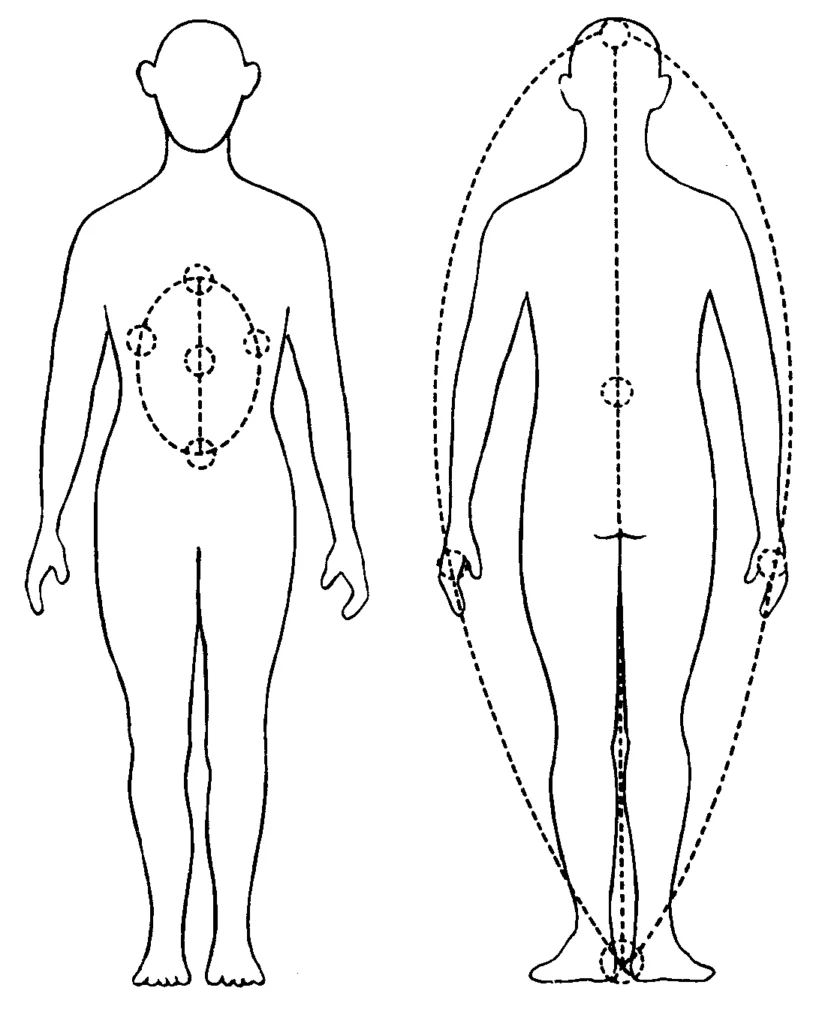
    The Yin Micro-cosmic Orbit, or Inner Ch’i Circling, is another of the specialized Taoist techniques. By breathing deeply through the lower abdomen (Tan T’ien – the Lower Cauldron or Stove) – and using special arm movements in cooperation with a partner, the student can learn how to lock his internal energy or vitality power into the five positions indicated on Diagram 1.

    The Yang Macro-cosmic Circle, Yin section, or Outer Ch’i Circle, is a dynamic breathing exercise that requires many years of practice at K’ai Men before it can even be attempted. This is because it demands a very strong Ch’i action, a dynamic depth of concentration within oneself, and positive mind control. The basic principle of the technique (see Diagram 2) is to breathe without taking an in- or out-breath (as usually understood), and it is accomplished through the soles of the feet, the middle of the spine and the top of the head. The internal energy is circled through these points and also out to the finger-tips. Only students who have spent many years practising all aspects of K’ai Men will fully appreciate what this means and how it is accomplished.

    Yang

    Yang breathing is very deep breathing because it concentrates on the utilization of the diaphragm. In the West it is generally known as diaphragmatic breathing. This way of breathing gives greater freedom to the lungs and so their absorption becomes more, but, because of the downward pressure on the abdominal organs, which gives them an internal massage, the abdomen is pushed outward. All this is stimulating to the lower abdomen and increases the amount of energy attracted from heaven. Another Yang way of breathing is to make your in-breath short and sharp, but exhale strongly and for as long as you can. This method of breathing is the best for your health, for it helps to generate enormous energy, gives the blood all the oxygen that it needs, purifies the blood by the absorption of waste matter, and helps to strengthen the nervous system and give health to the rest of the anatomy.

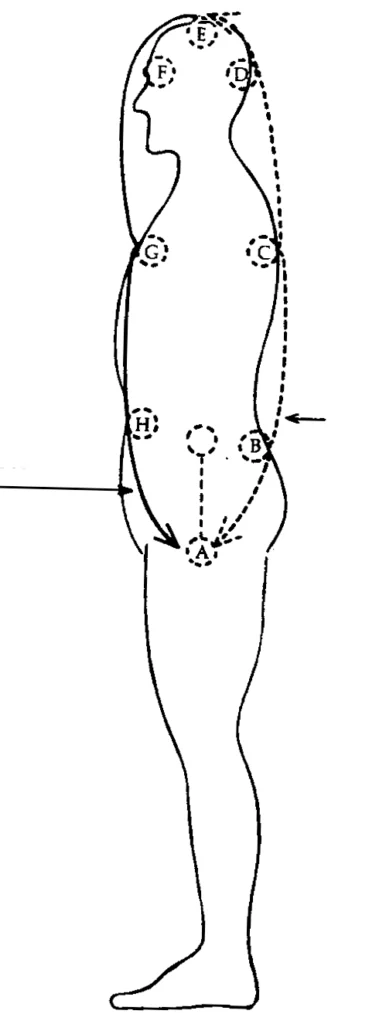
    The Yin Micro-cosmic Orbit, Yang section, combines the vitality power, or internal energy, with macro-cosmic energy. Through specialized breathing techniques these energies are raised as shown in Diagram 3: from point A up the spine to point E, at the top of the head. Both energies can be locked into the positions marked B, C, D, and E on the diagram, and these are known as the channels of control, which not only give positive and dynamic energy to the body and mind, but also vibrate the psychic centres and open up and strengthen the channel to the spirit.

    The Yang Macro-cosmic Circle in the Yang section is the completion of the entire circle, from point E back to point A, through F, G, and H, and after completion of the full circle the energies are controlled back to the lower abdomen or lower cauldron, where they are harnessed and revitalized. The openings from point E down the front of the body to point A are known as functional channels, and they are used to control the external use of the vitalities forces, for health and spiritual purposes. If you can get this far, then you are on your way to spiritual immortality through Taoist alchemy.

    Yin/Yang

    This is a series of breathing exercises whereby the in-breath is as strong and takes as long as the out-breath. This style of breathing attracts energy from both heaven and earth, in equal measure. (See Diagram 4.)

    Diagram 4. Yin/Yang section.
    Yang Macrocosmic circle and Yin Microcosmic Orbit.

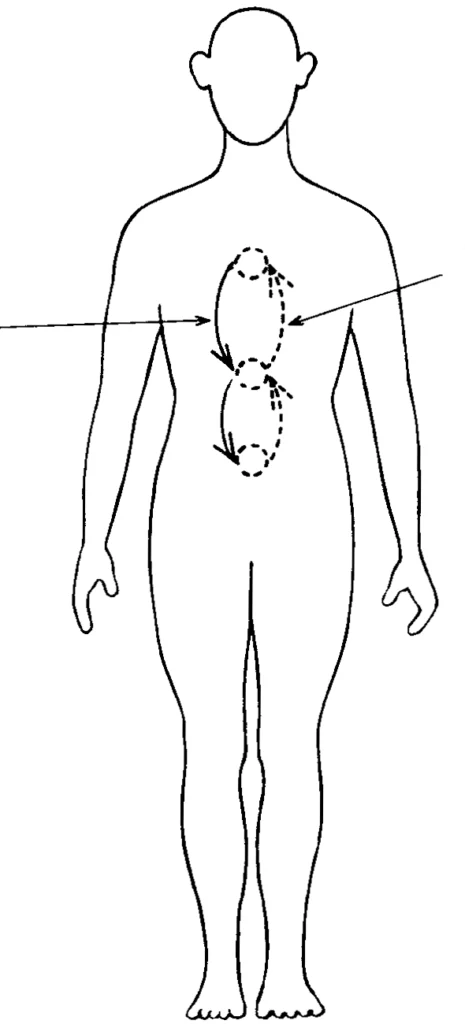
    The Yin Micro-cosmic Orbit, Yin/Yang section, consists of raising the breath and internal energy from the lower abdomen to the solar plexus and then driving it downward back to the abdomen. Placing one’s hands on those two spots aids the circling of the energy, and also helps to vibrate and pulsate the psychic centres that are there.

    The Yang Macro-cosmic Circle, Yin/Yang section, consists of lifting the breath and the internal energy through three levels, from the lower stomach, into the solar plexus and then into the heart, and then gently lowering them back through the same centres until they rest again in their natural home, the lower abdomen.

    In addition to the twenty basic breathing sequences in Taoism, there are many more, linked with physical movements and exercises. This makes the breathing and energy section of K’ai Men the most comprehensive and dynamic exploitation of the human body, the functions and vibrations of the psychic centres, the control channels to, from and within the mind, and the subconscious. The harmony of all opens the door to the spirit.

    The importance of breathing is greatest at the beginning and end of your earthly life. Did you know that the first thing a baby does at birth is exhale, and that the last thing a dying person does is inhale? In the latter case, the pressure that has been built up by inhalation acts on the weakness of the heart and brings death.

    All deep breathing brings about a harmony of Yin and Yang vibrations and pulsations, so learn to breathe deeply all the time, day in and day out, and utilize your full lung capacity, so that the body can obtain the maximum benefits. The various forms of healing in K’ai Men – meridian healing, Ch’i healing, breath healing, sound healing, meditation healing, Chinese push and pull massage, spot pressing and so on – are all founded upon the effective use of vibrations and pulsations.

    In K’ai Men, great emphasis is placed on correct and total breathing – irrespective of the type of breathing exercise being executed – and upon maintaining complete breath control at all times. All physical exercises in K’ai Men are split into two sections: the “sequence” in which deep breathing is of particular importance; and the “extension” in which full and constant mind and body control are the speciality.

    Regulated breathing under strictly controlled conditions will enable you to learn how to drive your breath downwards to the lower abdomen, so arousing the Lower Cauldron or Inner Fire, as it is sometimes known, and activating and pressurizing the internal energy held there. This in turn activates that energy so that it is forced up and rises as you inhale. When you exhale this relaxes the diaphragm, which takes the pressure off the lower abdomen, and the internal energy then sinks back to it, down the front of the body. There follow three different breathing exercises, each of which will in its own way help you internally.

    A Yang breath

    Diagram 5. Taoist ‘Four-directional’ Yang breathing exercise.
    Extracted from the Book of Supple Muscles (Ch’ing Period)

    This will give you a great deal of energy and will warm up the whole body, so if you feel cold this is really excellent. It will also help to kill off the bacteria of the common cold and influenza, and will generally tone up the whole system.

    Stand with your feet about the width of your shoulders apart, and your hands by your sides.
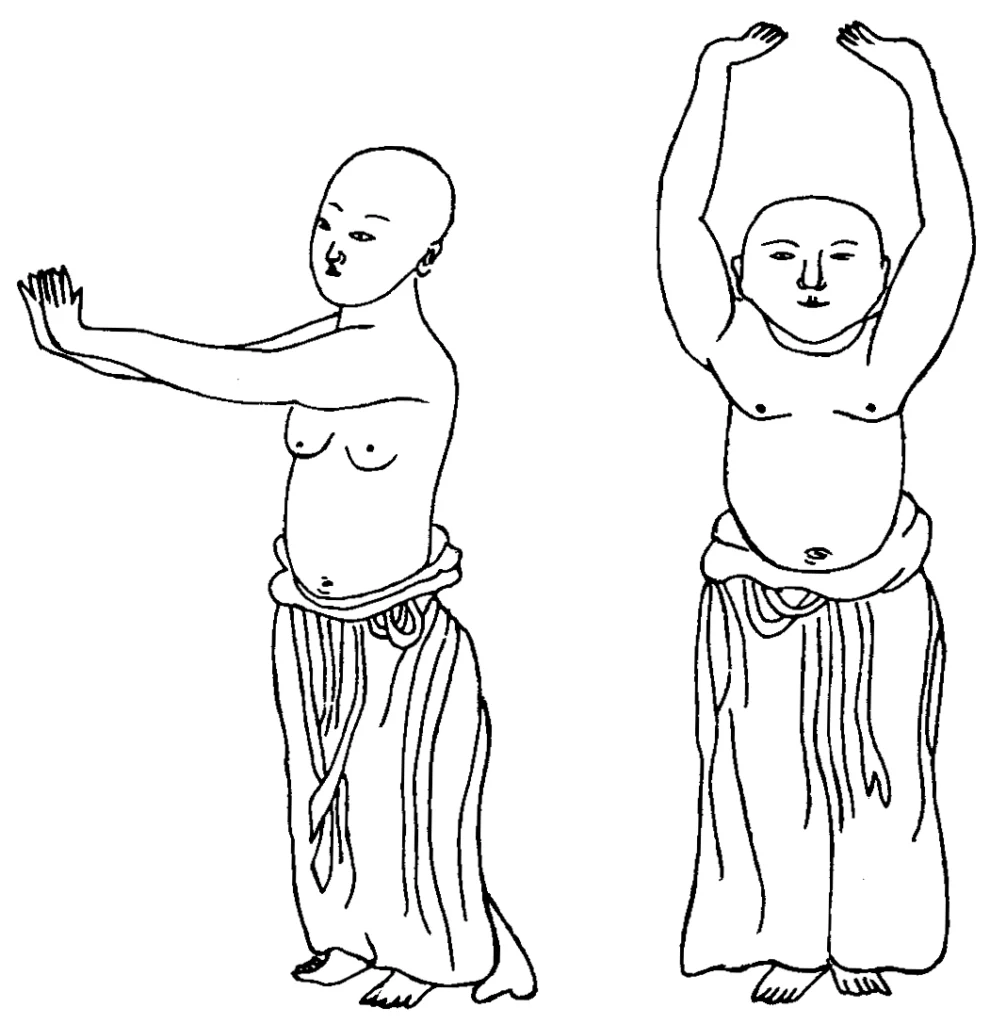
    1. Breathe in through the nose and raise the hands in front of the shoulders as you do so. Exhale slowly but very forcibly through the mouth, as you push slowly but strongly straight forward with the hands, extending the arms.
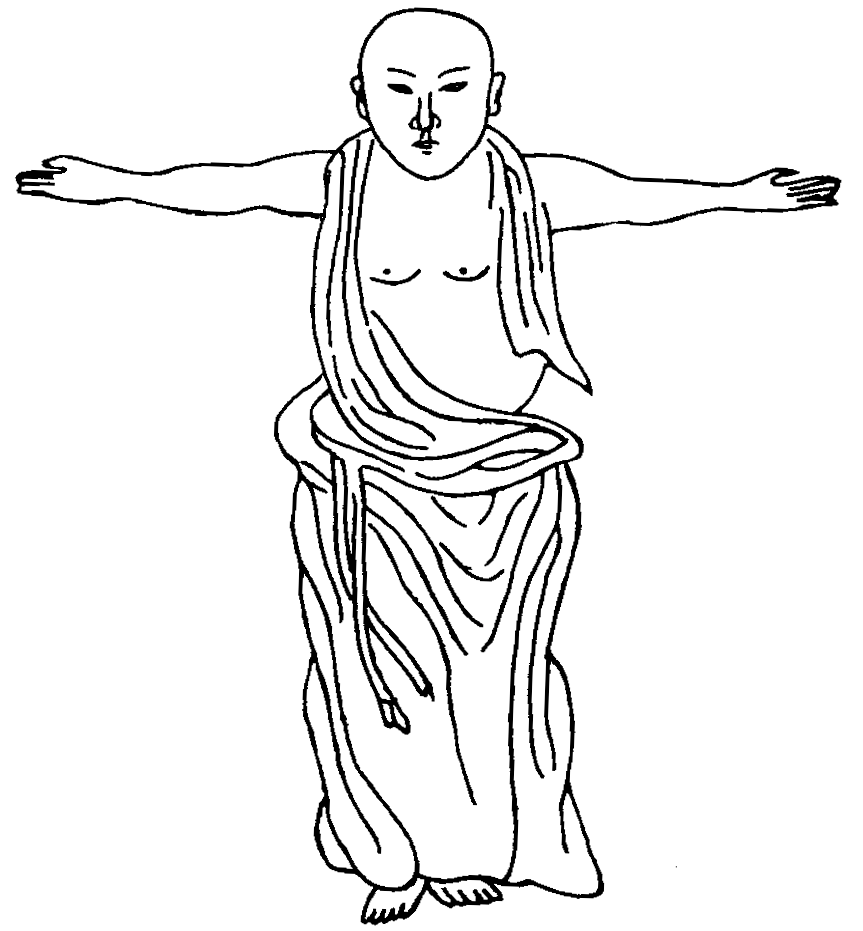
    2. Breathe in through the nose and allow the hands to come back in front of the shoulders. Exhale slowly but very forcibly through the mouth, as you push slowly but strongly sideways with the hands, till the arms are fully extended.
    3. Breathe in through the nose and allow the hands to come back in front of the shoulders. Exhale slowly but forcibly through the mouth, and as you do so push slowly but strongly directly upwards towards the ceiling.
    4. Breathe in through the nose and allow the hands to come back in front of the shoulders. Exhale slowly but forcibly through the mouth and simultaneously push slowly but strongly downwards, till your arms are fully extended by your thighs.

    Now repeat this sequence. You will really feel the benefits.

    A Yin breath

    This breathing exercise is excellent to do at any time of day, and will help clear the nasal passages and soothe the nerves, and enable the body and mind to relax completely. If you ever feel tense, or under strain, or think a headache is coming on, then try this exercise.

    You can sit down to do this exercise. Rest your right elbow on a table, and place the index finger of your right hand on your forehead, between your eyebrows (if you are left-handed, substitute left for right throughout the exercise).

    Now press your right thumb against your right nostril so as to close that nostril completely. Slowly inhale through your left nostril until you have filled your chest as much as you can, and then exhale just as slowly through the same nostril until all the air has gone. Now free your right nostril and press the middle finger of your right hand against your left nostril, so as to close it. Slowly breathe in again, filling your lungs and chest, and then slowly and completely exhale.

    These two movements comprise the full sequence, and if you repeat it five times you will find it very relaxing indeed; but ensure that the breathing is done continuously and that there is no time lag in changing from thumb and middle finger or vice versa.

    A Yin/Yang breath

    This exercise is excellent for the activation of energy and vibrates three psychic centres, which in turn revitalize the whole of the anatomy and mind. Make yourself comfortable either by sitting in a chair or, better still by sitting on the floor with your legs crossed. Keep the body upright, but do not hold it too stiffly. Place your right hand on your lower abdomen, and your left hand on the solar plexus – in both cases, directly on the skin.

    1. Now breathe in through the nose, but breathe deeply, so that the downward pressure pushes your right hand outward. Then press with your right hand on your lower abdomen so that the air is forced upward into the area of the solar plexus.
    2. Press with your left hand, so that the air is forced to rise up into the chest.
    3. Slowly exhale through the nose, allowing the chest to collapse.
    4. Press your left hand on the solar plexus so that all the air there is pushed out.
    5. Press with your right hand, so that all the air remaining in the lower abdomen is expelled.

    Don’t forget to breathe as deeply as you possibly can, and endeavour to do a minimum of six in- and out-breaths, following the above sequence.

    • Learn to breathe – and you will live.
    • Learn to breathe well – and you will retain good health.
    • Learn to breathe deep – and you will attain longevity.
    • Learn to breathe inwardly, without breathing – and you will gain spiritual immortality.
    • Follow the Taoist advice, now and always.

    From The Taoist Art of Kai Men

    by Chee Soo
  • Bestseller Bundle

    Bestseller Bundle

    Bestseller Bundle

    Where to Start – The Bestseller Bundle

    If you’re not sure which title to pick up first, this is the safest possible answer: the three books our readers return to most often, together in one set.

    The Bestseller Bundle includes the Chinese Art of Tai Chi Ch’uan, the Taoist Art of Feng Shou, and the Taoist Art of Kai Men – three foundational texts covering the physical form, the martial roots, and the internal healing arts side by side

    Bought individually, these three come to £56.85. As a bundle they’re £48.32.

    Get the Bestseller Bundle here